
THE RAP REPORT:
AI? Sub-genres?
What’s really going on with independent artists in 2026
Understanding the Underground
Hip hop is the world’s biggest musical movement. As a style, it’s everywhere, topping charts and breaking boundaries. Yet big-name artists and the stereotypical hustle are only the tip of a much bigger iceberg. Arguably, hip hop lives and thrives in the underground, where real people use music to express themselves, discover new sounds, and create connections.
But what do we mean by underground? As music journalist Dylan Green wondered in a recent piece in Pigeons and Planes, the term has been so overused in this day and age that it can feel meaningless. It’s not just experimental rappers or “cloud rap,” the general term for the sounds that grew from places like Soundcloud in the late 2010s.
So let’s be specific about the underground we’re talking about. For us and for the artists who responded to this survey, it’s safe to say that underground hip hop is the sound of a self-sufficient, mutually supportive community of people who put everything into the music and the culture. They are in it to win it, sure, but they are also making tracks and beats to share part of themselves. Hip hop in this underground is a process, a relationship, not just a genre or marketing gimmick.
These creators are a distinctive, fascinating group. While they are influenced by more “mainstream” trends and sounds, they are primarily making music for themselves and their community. Their perspectives reflect the rarely discussed and, in fact, very substantial territory between bedroom rap stars and stadium-touring artists. They are more than casual hobbyists, yet likely not earning their full living from making music.
This category of artists is one of music’s fastest growing, a group that defies past labels of “pro” versus “amateur” and “signed” versus “independent” artist. Rap Fame’s community and the broader hip hop creator economy are part of the shift away from a music industry-defined definition of commercial success toward passion, a move that doesn’t exclude making money, but that puts priorities elsewhere. They live somewhere between passive music listening and fandom and fulltime creative professionals who earn their livelihood solely from music. There are tens of millions of these new creators worldwide, orders of magnitude more than traditionally defined music professionals, and the market serving these creators may grow to $10B by 2030, according to MIDiA Research.
This world matters not only because it’s big and growing fast, but because it’s from this underground that the future trends grow. Every big name started off making or jumping on beats on a laptop or phone, and tons of deeply influential rappers maintain this DIY, pro-community spirit.
Meet the Crew
The survey was conducted among Rap Fame users in early spring 2026. Approximately 1500 creators responded to the survey.
With 1M+ active users, Rap Fame provides underground hip hop an online home, as well as a toolkit to create music and help beginners level up. People come to Rap Fame to record tracks that they’ve been working on, as well as upload finished songs.
Since November 2025, we’ve seen user behaviours shift, with artists increasingly focused on sharing finished music, with uploads increasing 25x over this period. In March alone, more than 145K tracks were shared, the equivalent of a new song every 18 seconds. This highlights a clear evolution: Rap Fame is no longer just a place to make music, but a place to release it.
This shift is driven by what artists value most. In the Spring survey, 40.9% of respondents ranked building a fan community above social reach and streaming numbers. On Rap Fame, that community is highly active, with artists leaving over 150K comments on tracks every day, more than 4.6M per month. This constant feedback loop allows creators to improve, connect, and build an audience with every new song, something that traditional platforms seldom offer.
Creation also remains at the heart of the experience. 1.1M+ recording attempts each month, show users aren’t just posting music, they’re actively writing, experimenting, and refining their sound. Rap Fame isn’t a passive listening platform, it’s a creative space where artists consistently put in the work.
Genre Flow
Genre? What genre? The answer is seriously fluid in underground hip hop.
Creators know all the genres and subgenres that define hip hop, but they don’t really care where their tracks fall. More than 83% of creators report a fluid sense of style, drawing on whatever genre catches their ear or feels right for the mood or lyrics. They seek out what hits and what people resonate with. This means underground hip hop is seeing a wild mix of genres, though as we’ll see, there’s one big musical direction that’s on many creators’ minds.
Right now, trap and drill are king, with almost 50% of all creators making tracks in those styles. But boom bap still registers in the top five, along with melodic rap and experimental. When creators think about the future, what they think will dominate next year, the picture shifts: melodic rap steals drill’s spot, and rage and experimental climb the future genre charts to unseat boom bap. Which is no surprise given the recent rise of acts like Playboi Carti and his “Opium” label featuring rising stars Ken Carson & Destroy Lonely.
Melodic’s rise is no coincidence. It’s in perfect harmony with the overall vibe shift creators seem to be feeling about hip hop, that’s it’s all about community and emotional authenticity, something deeper and more human than the “barwork” focused artists that came before.
What Artists Are Making Now
What Will Dominate in the Next Year
Don’t Believe the AI Hype
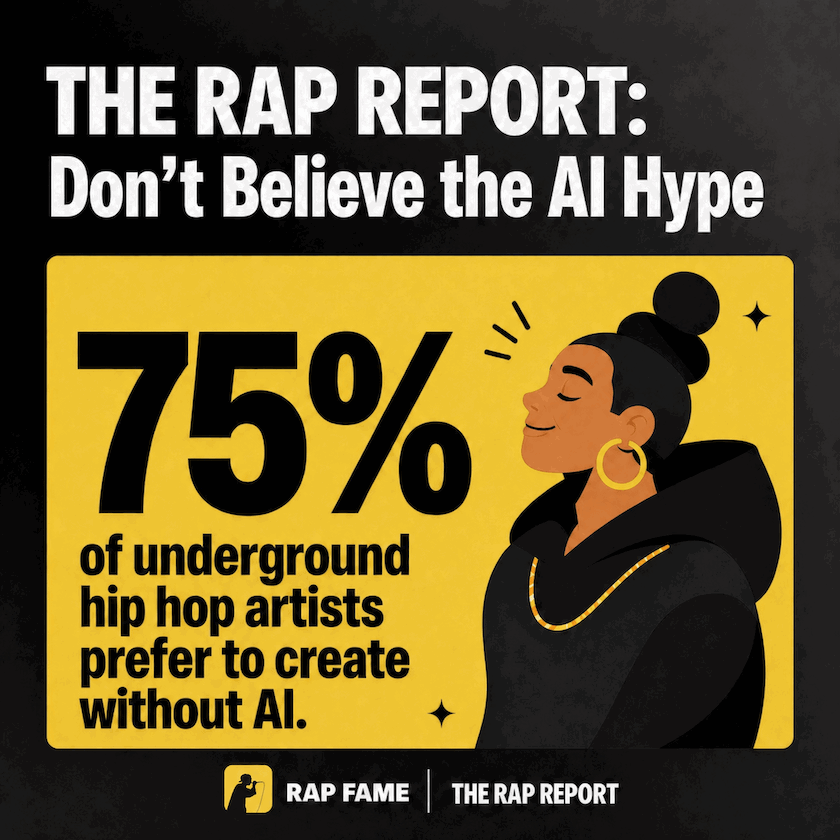
75% of underground hip hop creators don’t use AI—at least not when they’re making tracks. Only 2% reported using generative AI tools regularly in the musicmaking process.
That’s the exact opposite of artists working in other genres like rock, pop, and jazz, according to other recent research. A recent report by music industry research consultancy Water and Music found that 75% of artists and producers surveyed did use AI in their creative process.
This is likely due to cultural attitudes to authenticity within hip hop, as well as differences in how AI is integrated into production workflows. Heavily produced music genres increasingly use AI in the background, while in rap music, the associated blends are closer to replacing the artist’s own creative output than assisting and are therefore being adopted with more caution.
AI Usage in Underground Hip Hop
AI Usage in Other Genres in Past 12 Months
Hip hop artists want to craft their own bars and beats using more traditional, hands-on methods, or work with collaborators who do. The process, the friction involved, is part of the pleasure of making a track. Many Rap Fame users talk about how they benefit from working through their feelings and personal struggles by laying down bars and beats. AI might come in handy for generating art to go along with a single, for example, but it gets in the way if your goal is sharing your own voice and speaking from the heart.
AI may not be a tool underground hip hop artists use, but they are tech savvy and often digital first. Artists report that they have thrived thanks to the internet and its capacity for letting far-flung people find each other online. More than 68% have found collaborators online and use online tools to make and work on music together.
Technology has also influenced how creators structure their tracks. Creators are shaping their releases in specific ways that capitalize on tech trends in hopes of winning fans. Creators report putting hooks earlier in tracks to gauge people’s attention. In response to the rise of TikTok, many artists also go for shorter, more “viral-friendly” structures. With these trends repeating across genres.
Bros Before Follows
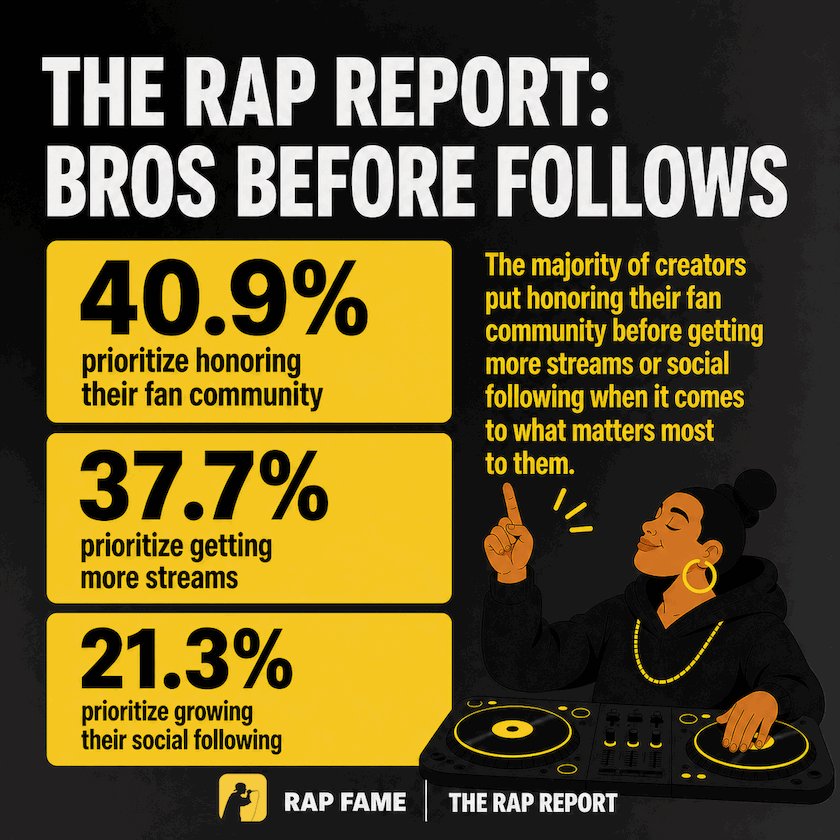
The majority of creators who responded put honoring their fan community (40.9%) before getting more streams (37.7%) or social following (21.3%) when it comes to what matters most to them. Though artists in the hip hop underground want to be heard (the overwhelming majority of artists wish they could crack discovery and promotion), they want to be heard by the people they feel a connection with. Music is about finding your people, not hitting the industry benchmarks of success.
Rap Fame’s community is unusually supportive: Creators on Rap Fame spend a lot of time commenting on each other’s work, more than 150k+ comments on people’s tracks every day. That’s roughly 4.6M comments per month, a lot of feedback that many appear to value highly. This interaction is especially important as creators are often putting it all out there, expressing themselves as a way to cope.
This overwhelming amount of interaction is in stark contrast to other social platforms. Content posted on Rap Fame in March 2026 achieved an overall engagement rate of 55.8%, significantly outperforming mainstream social platforms and indicating exceptionally high community interaction. By comparison, industry benchmarks from sources such as Buffer and SociaVault place typical engagement at 3–5% on TikTok, 2–4% on YouTube, and 1–3% on Instagram for short-form video content. Rap Fame’s community is talking to each other, and this suggests where real online social engagement is heading: to specialized communities who care about the same things.
Mood Music
Underground hip hop has fallen for melodies. Melodic hip hop is on the rise according to the creators when they named what genres they favor and think will dominate in the coming year. As they lean into melody-led production, artists appear to want to be more emotionally expressive, underlining how many creators use hip hop to process their emotions and experiences.
This goes deeper than melodies. It’s also showing up in the beats creators make or choose. About 30% of users are creating sad or emotional beats, which ties into the idea that people use Rap Fame to express themselves and maybe dispel negative/sad emotions into their music rather than keeping them bottled up inside. This reflects the ongoing conversation many creators are having, that hip hop is their chosen outlet for improving their mental health by expressing their inner worlds.
Along with creators choosing to express their true emotions and be seen as who they are, visibility remains a major challenge. Nearly 70% of survey respondents identified discovery or promotion as their biggest struggle as independent artists. In response, Rap Fame provides tools such as live matching and a feedback engine designed to increase exposure, encourage constructive feedback, and help artists stand out, offering a level of discoverability that is often harder to achieve on mainstream social and streaming platforms.
It’s All About Authenticity
The biggest takeaway: underground hip hop values authenticity first and foremost. This has long been the case, but keeping it real means so much more today, in an era of endless streams of generated sounds and retouched content. People want to be fully human and to share this humanity with others who also love to create music, write lyrics, and make beats.